

Last Updated: November 22, 2026
Quick Summary
To curl hair using a straightener, clamp a 1 to 2 inch section near the roots, rotate the iron a half turn for loose curls or a full turn for tighter curls, then glide slowly down the length. Release and let each curl cool in your hand before touching it.
- Use a straightener with rounded plate edges and always apply heat protectant first.
- Start one heat setting lower than you think you need and test one section.
- Glide at a slow, even pace of roughly 2 to 3 seconds per section.
- Pin each curl to your scalp for five to ten minutes while it cools.
- For beach waves, take 2-inch sections and rotate just 180 degrees.
Table of Contents
- What You Need Before You Curl Hair With a Straightener
- How to Curl Hair Using a Straightener, Step by Step
- How to Make Waves With a Straightener
- How to Curl Short Hair With a Straightener
- How to Make Straightener Curls Last
- Choosing the Best Straightener for Curling Hair
- Fixing Curls That Fall Flat or Come Out Uneven
- Pick Your Straightener and Start Curling
- Frequently Asked Questions
What You Need Before You Curl Hair With a Straightener
You can absolutely curl hair using a straightener, and you probably already own the one tool you need. A flat iron with rounded edges does the job of a curling wand once you learn the clamp, rotate, and glide motion. If you want to confirm a straightener suited to your hair type before you start, see Choosing Hair Styling Tools for Your Hair Type. This guide walks you through the full process from prep to finish.
Here is what to gather before you start:
- A straightener with rounded plate edges
- A heat protectant spray or serum
- A comb and a few sectioning clips
- A light-hold hairspray for finishing
Skip the heat protectant and you risk dry, split ends over time. This step matters more than any temperature setting.
Preparing Hair So Curls Hold
Clean, fully dry hair holds a curl far better than hair styled a day after washing. Natural oils and leftover product weigh strands down, so curls slide out within hours.
Start with dry hair only. Never curl wet or damp hair with a flat iron.
Work through tangles first with a detangling brush. Smooth, knot-free hair means the plates glide evenly and your curl pattern stays consistent.
A common mistake is loading up on heavy styling cream before curling. Use a light heat protectant instead, and save richer products for after styling.
How to Curl Hair Using a Straightener, Step by Step
The core method takes about 15 minutes once you get the rhythm. Clamp a section, rotate the iron, glide down, and release.
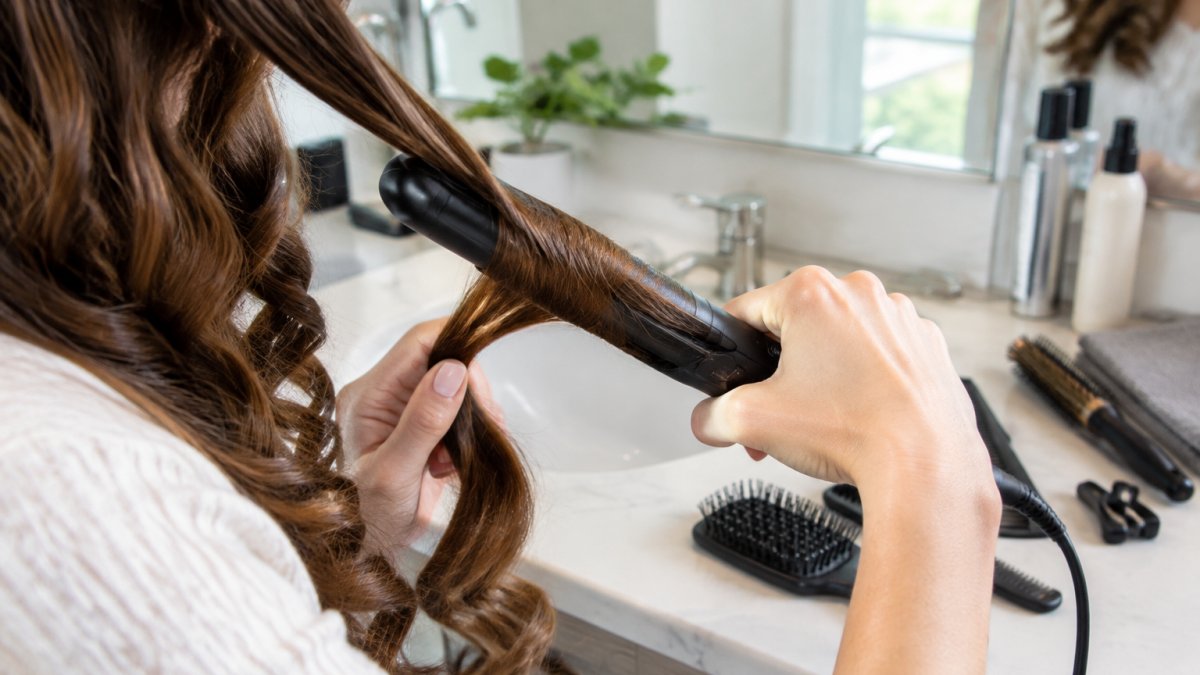
Here is the full sequence:
- Heat the iron to a setting that suits your hair type (see the temperature guide below).
- Spray heat protectant and comb through.
- Divide hair into sections with clips.
- Clamp a section near the roots.
- Rotate the iron a half turn or full turn.
- Glide slowly down the length.
- Release and let the curl cool in your hand.
Choosing a Temperature by Hair Type
Temperature is the variable most people guess at, and it is the one that decides whether you get a lasting curl or a heat-damaged strand. Fine or damaged hair generally responds to lower heat, medium hair to a middle range, and thick or coarse hair to higher heat.
A practical test: start one setting lower than you think you need, curl one section, and let it cool fully. If the curl holds its shape after it cools, the temperature is right.
Plate Material, Plate Width, and Curl Shape
Rounded plate edges help prevent creases when you rotate the iron, which makes them useful for curling.
Sectioning and Holding the Straightener
Section width controls your curl size. Take sections about 1 to 2 inches wide for defined curls. Wider sections give you looser, beachier waves.
Clip the top half of your hair up and work from the bottom layers first. Hold the iron at a slight angle rather than straight down, which helps the hair wrap smoothly around the barrel. Keep the clamp closed on the section and let the rotation, not the clamp pressure, do the work.
The Rotate and Glide Motion
This is the part most people get wrong. Clamp the hair, then rotate your wrist a half turn, either 180 degrees, for a loose curl. A full turn gives you a tighter curl.
Glide the iron down at a slow, even pace, roughly 2 to 3 seconds per section for medium hair. Rushing the pass creates a kink instead of a curve. One slow pass beats two fast ones every time, because a second pass over already-curled hair re-heats the bend and flattens it.
Release the hair and cup the curl in your palm while it cools. Warm curls stretched too early fall flat fast. Let each curl sit for a few seconds before you move on, and pin the top sections while they cool if you want more hold.
How to Make Waves With a Straightener
Loose beach waves come from the same motion with two tweaks: wider sections and a half turn only. Take 2-inch sections and rotate just 180 degrees.
Glide down and pull the iron slightly outward as you release. That outward pull softens the bend into a wave rather than a ringlet. Alternate the direction of each rotation for a more natural, lived-in look.
How to Curl Short Hair With a Straightener
Short hair curls faster but needs a gentler hand. Use narrower sections, about 1 inch, and keep the iron moving.
For hair above the chin, clamp closer to the ends and rotate away from your face. Hold for a few seconds only, since short strands heat through quickly. A mini straightening brush also works well for quick touch-ups on shorter layers.
How to Make Straightener Curls Last
Curls that fade by lunchtime usually mean one of three things: hair was too dirty, the iron was too cool, or the curl was stretched before it cooled.
Pin each curl loosely to your scalp with a clip while it cools. Let them sit for five to ten minutes, then release and shake out gently.
Finish with a light-hold hairspray. For extra staying power, work a small amount of a jojoba oil hair mask through the ends between washes to keep hair hydrated and flexible.
Choosing the Best Straightener for Curling Hair
The best straightener for curling hair has rounded plate edges, steady heat control, and plates that grip without snagging. Flat, sharp-edged plates are built for straightening only and leave dents when you rotate them.
Here is how our picks compare:
| Straightener | Price | Best For | Key Feature |
|---|---|---|---|
| Dyson Corrale Refurbished | $329.99 | All hair types, cordless styling | Flexing copper plates, 3 heat settings |
| Relaxus Digital Straightener | $29.99 | Budget shoppers, travel | 5-inch ceramic plates, up to 450°F |
| Relaxus Mini Brush | $17.99 | Quick touch-ups, short hair | Ceramic bristles, 375°F |
Price
The Dyson Corrale straightener is one option to consider. Its flexing copper plates shape around hair. It also runs cordless for up to 30 minutes and has three heat settings for different hair types.
If you want an affordable starter tool, the Relaxus digital straightener has extra-long ceramic plates and a 360-degree swivel cord for easy rotation.
Fixing Curls That Fall Flat or Come Out Uneven
Most curl problems trace back to one of four causes: inconsistent sections, uneven glide speed, heat that is too low or too high for the hair, or handling the curl before it cools. Work through them in that order rather than changing everything at once, because two fixes applied together make it hard to tell which one worked.
Diagnosing the Problem
- Curls fall flat within an hour: the iron was too cool, the hair was too dirty or product-heavy, or the curl was stretched before it cooled. Raise the heat one step, wash and dry hair fully, and pin each curl until it is cool to the touch.
- Curls come out uneven: section widths or glide speeds are inconsistent. Cut every section to the same width and count a steady 2 to 3 seconds per pass.
- Kinked ends instead of a curve: the iron is clamped too hard at the last inch or paused mid-glide. Slow down at the ends and keep the iron moving through the release.
- Crease marks near the roots: the clamp was closed too close to the scalp on a high setting. Start the clamp an inch or two down from the root and rotate before gliding.
- Snagging or pulling: the section is too wide for the plate, the hair is not fully detangled, or product has built up on the plates. Clean the plates and take narrower sections.
- Frizzy finish: heat is too high or there is no protectant. Drop the temperature and add a light heat protectant before the next pass.
- Flat top layer: the top sections were curled first and then weighed down by the rest of the styling. Curl the top layer last and avoid brushing through it while warm.
Fixing the Curl Without Re-Doing the Whole Head
For a single fallen curl, re-clamp the section, rotate in the same direction, and hold for a few seconds longer than the first pass, then let it cool in your hand before releasing. For a kink, run the iron slowly through the bend once at a lower temperature rather than clamping hard, which sets a second crease.
Watch out: re-curling the same section repeatedly at high heat is the fastest way to rough up the cuticle, so limit yourself to one corrective pass per section.
Preventing the Problem Next Time
A few habits remove most of these issues before they start. Keep section width and glide speed identical across the head. Let every curl cool fully before you touch, brush, or spray it. Use the lowest temperature that produces a lasting curl rather than the highest the iron offers. And finish with a light-hold hairspray rather than a heavy one, since heavy product weighs curls down and makes them drop faster.
Pick Your Straightener and Start Curling
Curling with a straightener comes down to three habits: prep hair properly, rotate with control, and let each curl cool before you touch it. Get those right and the tool you already own becomes a curling iron.
At Home Essentials Outlet, we stock brand-name styling tools at outlet prices, backed by our own warranty on factory-serviced items. The Dyson Corrale listings we carry are refurbished by Dyson and come with a one-year Dyson warranty.
Ready to trade the guessing game for a tool that curls and straightens in one pass? Shop our personal care deals and find your next straightener at an outlet price.
Frequently Asked Questions
Should your hair be wet or dry before curling it with a straightener?
Always curl dry hair. A flat iron on damp hair traps water inside the strand, and the sudden heat can cause steam damage and uneven curls. Wash and dry your hair fully first, or start on second-day hair. Apply a heat protectant to dry hair, comb it through, and let it settle for a minute before you clamp. If your hair is still cool to the touch at the roots, it is not dry enough yet.
What temperature should a straightener be for curling hair?
Match the heat setting to your hair type. Fine or damaged hair generally needs lower heat, while thick or coarse hair may need more. The Dyson Corrale at Home Essentials Outlet offers three settings (330°F, 365°F and 410°F) plus intelligent heat control that adjusts to your hair's thickness and texture. Start lower than you think you need; you can always add heat, but you cannot undo scorching.
Can you curl short hair with a straightener?
Yes. Short hair actually curls quickly because there is less length to wrap. Use narrower sections, about 1 to 2 cm wide, clamp close to the roots, and rotate only a half turn before gliding down slowly. Keep the iron moving so the short ends do not crease. A mini tool can help on very short layers; the RELAXUS Mini Brush Out ceramic straightening brush is priced at $17.99.
Why do curls fall out after using a straightener?
Most curls drop because the hair was clamped too long in one spot, the section was too thick, or the curl was not cooled before being touched. Work in thin sections, glide at a steady slow pace, and let each curl cool completely, ideally pinning it in a ringlet until it sets. A light hold hairspray and a cool blast from your dryer at the end lock the shape in place.


