

Table of Contents
- Assess Your Space and Set a Budget for Your Home Workshop
- Essential Woodworking Tools for Beginners
- Small Garage Workshop Layout Ideas
- How to Organize a Workshop on a Budget
- Tool Rental vs. Ownership: When to Buy and When to Rent
- Used Tool Inspection Checklist
- Plan for Future Expansion Without Overspending
- Frequently Asked Questions
Last Updated: October 9, 2026
Assess Your Space and Set a Budget for Your Home Workshop
Starting a home workshop budget doesn't mean compromising on quality. At Home Essentials Outlet, we help customers build functional workshops in garages, basements, and spare rooms by matching their budget to their needs.
Most people buy tools first, then figure out where to put them. That's backwards. Your space dictates tool selection, storage, electrical requirements, and expansion plans.
Start with these three questions:
- How much usable floor space do you have? (Measure in metres, account for doors and windows)
- What's your realistic budget? (Be honest about what you can spend now, not what you wish you could spend)
- What projects do you actually want to build? (Furniture, repairs, small items?)
A typical beginner home workshop budget breaks down like this:
| Budget Level | Tools | Storage | Workbench | Electrical/Lighting |
|---|---|---|---|---|
| $300-500 | Hand tools + one power drill | Basic shelving | DIY or used | Outlet strips, basic bulbs |
| $500-800 | Cordless combo kit + circular saw | Toolbox + wall pegboard | Workbench kit | Upgraded lighting, dedicated circuit |
| $800-1,200 | Multiple power tools + accessories | Shelving + organizers | Built workbench | Professional lighting, safety upgrades |
Your budget should reflect your actual use. A hobbyist building one bookshelf per year doesn't need the same investment as someone doing weekly projects.
Essential Woodworking Tools for Beginners
You don't need fifty tools to start, just the right few used correctly. The essentials split into power tools that speed up work and hand tools that give you control and precision.
Power Tools vs. Hand Tools: What to Prioritize
Power tools save time; hand tools save money and give better control on smaller projects.
A cordless drill is your foundation. The DeWalt 20V MAX Combo Kit includes a drill and impact driver, two tools that handle most beginner jobs.

Hand tools you'll actually use:
- Hammer (16 oz, curved claw)
- Tape measure (5-metre minimum)
- Combination square (for marking and checking angles)
The mistake most people make: they buy a 100-piece tool set. Ninety pieces stay in the box. Buy only what matches your first three projects.
Budget-Friendly Tool Acquisition: New vs. Refurbished
New tools cost more; refurbished tools cost less and often perform identically. Refurbished tools are returns or display units that pass a rigorous inspection and dozens of tests to meet all manufacturers specifications. They are like-new and come with a warranty.
When to buy refurbished:
- Power tools (drills, impact drivers, saws), performance is identical
- Storage solutions (toolboxes, organizers), cosmetics don't matter
- Safety gear (glasses, gloves), brand new isn't required
Used tool markets offer deals, but with risk: you can't test a used saw before buying it, and you don't know if it was abused.
Small Garage Workshop Layout Ideas
Your layout determines how safely and efficiently you work. A cramped, poorly organized space frustrates you. A thoughtful layout makes every project easier.
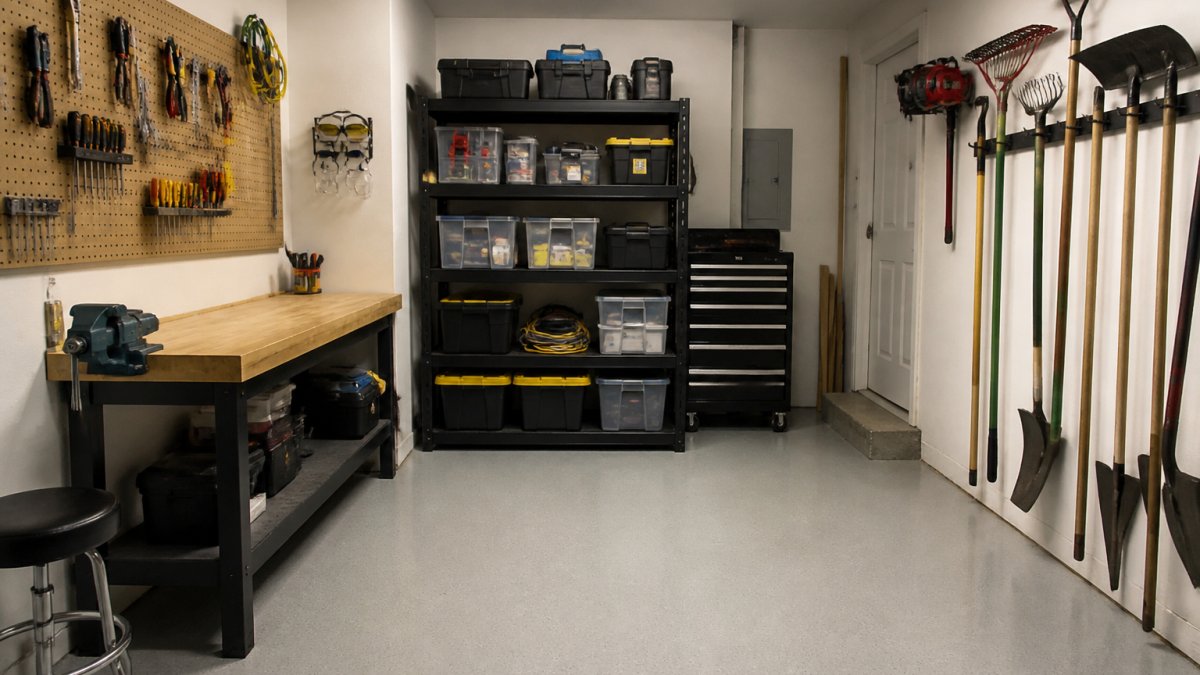
The golden rule: keep your work surface clear and your floor open, with tools and materials within arm's reach but not in your way.
Start with these zones:
- Work zone: Your workbench in the center or against a wall
- Storage zone: Shelving and pegboards on walls, keeping floor space open
- Material zone: A corner or shelf for stock wood, hardware, and supplies
Most home workshops fail because they're too cramped. You need at least 1.5 metres of clear floor space to move safely; if your garage is tight, go vertical with wall-mounted storage, overhead racks, and fold-down workbenches.
Workbench Selection and DIY Builds
Your workbench is the heart of your workshop, but it needn't be expensive.
A basic workbench needs:
- Solid, flat surface (at least 1.2 metres long, 0.6 metres deep)
- Sturdy legs that won't wobble
- Height around 0.85 metres (comfortable for standing work)
Budget options:
- Buy a kit workbench ($200-400): Pre-cut materials, assembly required. Takes 2-3 hours to build.
- DIY from 2x4s and plywood ($80-150): Basic carpentry skills needed. Most flexible option.
- Used workbench ($50-200): Check used listings. Inspect for flat surface and solid joints.
A flat surface matters most: if your workbench rocks or tilts, every project suffers.
Electrical Safety and Workshop Lighting
Poor lighting causes mistakes and injuries. Bad electrical setup causes fires. Neither is worth saving money on.
Lighting needs:
- Overhead: Bright, even illumination across your entire workspace (LED panels, 4000K colour temperature)
- Task lighting: Focused light over your workbench (adjustable lamp or under-cabinet strips)
- Ambient: General light so you're not working in shadows
Most garage outlets share a circuit with your home, so running multiple power tools at once can trip the breaker. Check your circuit capacity first.
Safe electrical practices:
- Never run extension cords across your work area (trip hazard)
- Use grounded outlets for all power tools
- Install a dedicated circuit if you run tools frequently
If your breaker trips regularly, hire an electrician to add a dedicated circuit. It's worth the cost.
How to Organize a Workshop on a Budget
Organization prevents lost time and lost tools. Start simple: you don't need a perfect system, just one that works for how you actually work.
Tool Storage Solutions That Scale
Storage should grow with your workshop. Buy modular solutions that stack and expand.
DEWALT 20V MAX* Cordless Drill and Impact Driver, Power Tool Combo Kit →
Budget-friendly storage:
- Pegboard and hooks ($30-60): Wall-mounted, customizable, visible at a glance
- Plastic shelving units ($40-80): Portable, expandable, holds heavy loads
- Toolbox or organizer ($25-60): Portable storage for small tools and bits. The DeWalt Mid-Size PRO Organizer at Home Essentials Outlet costs $25.99 and features removable cups and stackable design, ideal for small parts and fasteners
The CRAFTSMAN toolbox at Home Essentials Outlet ($42.99) holds up to 66 pounds and features water-resistant construction. For a beginner, this single box stores most hand tools and keeps them portable.

Organize by frequency:
- Daily use: Within arm's reach of your workbench
- Weekly use: On pegboard or nearby shelf
- Occasional use: In drawers or upper shelves
Dust Collection and Maintenance
Dust damages tools and your lungs. A simple dust collection system prevents both.
Basic dust control:
- Sweep regularly (prevents buildup)
- Use a shop vacuum for power tool use (captures 80 percent of dust)
- Wear a dust mask when sanding or using circular saws
Maintenance extends tool life:
- Wipe down tools after use (prevents rust)
- Check batteries before each use (charge overnight)
- Replace dull blades (they strain the motor)
Tool Rental vs. Ownership: When to Buy and When to Rent
Not every tool deserves a permanent home in your workshop. Some tools sit unused for months.
Rent when:
- You use the tool once per year or less
- The tool is expensive ($300+)
- You're testing whether you'll actually use it
Buy when:
- You use the tool monthly or more
- You can afford the upfront cost
- The tool matches your long-term projects
Example: A miter saw costs $200-400. If you use it twice per year, renting ($20-30 per day) is cheaper than buying. If you build furniture monthly, buying pays for itself in a year.
Track your tool use. After six months, review what you've actually used. Rent the rest.
Used Tool Inspection Checklist
Used tools offer savings, but with risks. The difference between a bargain and a money pit is knowing what to inspect and how to test it. Most guides give you a list; this one gives you a procedure.
Before You Leave Home
- Ask for the model number and look up the replacement cost. If the asking price is more than 60 percent of new, the savings do not justify the risk.
- Check whether the tool is still in production; discontinued models mean discontinued parts.
- Ask the age and whether it was used professionally or occasionally. A ten-year-old tool used twice a year often beats a two-year-old tool used daily on a job site.
The Hands-On Inspection
Power cord and plug
- Run your hand along the cord, feeling for cuts, flat spots, or stiff sections where the insulation has hardened.
- Check the plug for bent prongs, cracks, or signs of overheating (discoloration or a burnt smell).
- Plug it in and wiggle the cord near the strain relief; if the tool cuts out, the internal wiring is compromised.
Switches and controls
- Trigger the switch several times; it should respond immediately and smoothly, with a clear on/off action.
- Test any speed dials, reverse switches, or mode selectors through their full range.
- A sticky or intermittent switch signals internal wear or debris. It is fixable, but factor the repair into your offer.
Motor and drivetrain
- Run the tool for at least 30 seconds under no load. Listen for grinding, rattling, or high-pitched whining. A healthy motor has a steady, consistent sound.
- Smell the exhaust vents. A burnt electrical smell means the motor has overheated or the brushes are worn.
- For belt-driven tools, remove the belt and spin the pulleys by hand. They should turn freely without wobble or grinding.
Chuck, collet, or blade mount
- Insert a bit or blade and tighten it fully. It should grip evenly and not wobble when you spin it by hand.
- For drills, check that the chuck jaws close evenly. A chuck that grips off-center will drill oversized holes.
- For saws, check the blade arbor for runout. A bent arbor is a deal-breaker.
Housing and structure
- Look for cracks, especially around mounting points and handles. Hairline cracks in plastic housings spread under vibration.
- Check all fasteners. Missing or stripped screws suggest the tool has been opened and possibly reassembled incorrectly.
- For benchtop tools, check the table or base for flatness. A warped table cannot be fixed economically.
Batteries (cordless tools)
- Ask the seller to charge the battery fully before you arrive.
- Run the tool under load (drill into scrap wood, or run the saw through a piece of stock) for at least five minutes. A healthy battery maintains power; a failing one bogs down or dies quickly.
- Check the battery contacts for corrosion or burning.
Calibration and Accuracy Checks
This is the step almost everyone skips, and it is where money pits hide.
- Table saw: Check that the blade is parallel to the miter slot. A misaligned saw cannot cut accurately and may be expensive to fix.
- Miter saw: Set it to 90 degrees and check the cut against a square. If it is off, the detents may be worn or the fence bent.
- Drill press: Check runout with a dial indicator, or visually check for wobble with a long bit installed.
Questions to Ask the Seller
- How often was it used, and for what kind of work?
- Why are you selling it?
- Has it ever been repaired or serviced, and by whom?
When to Walk Away
Walk away if:
- The motor smells burnt or runs rough under load.
- The cord is damaged and the seller will not let you test it.
- The housing has cracks around structural points.
A cheap broken tool costs more than a refurbished one with a warranty. Your time, your safety, and your project quality are worth more than the few dollars you save on a questionable purchase.
Plan for Future Expansion Without Overspending
Your workshop will grow, so plan for it now. In six months you'll want tools you didn't anticipate; in a year, new projects will need new equipment. Building with this in mind prevents costly mistakes.
Expansion strategy:
- Leave wall space: Don't fill every inch with shelving now. You'll need room for new tools.
- Use modular storage: Stackable shelves and organizers adapt as your needs change.
- Buy quality basics: A good workbench and storage system outlast multiple cheap ones.
Start small. Grow intentionally. The best workshop is the one you actually use.
Frequently Asked Questions
What are the essential power tools for a beginner home workshop?
Start with a cordless drill-driver and impact driver combo kit, a miter saw for crosscutting, and a circular saw for ripping boards. A cordless combo kit like the DEWALT 20V MAX Brushless (available refurbished at $189.99) covers drilling and fastening for most DIY projects. Add a miter saw and circular saw as your second phase. Hand tools like squares, levels, and measuring tapes complete the basics. Prioritize cordless tools for flexibility in small spaces.
How much space do I need for a functional home workshop on a budget?
A functional workshop requires a minimum of 100-150 square feet, though you can start smaller. A single-car garage (about 250 square feet) is ideal for beginner DIY work. Focus on vertical storage to maximize your available space. Mount shelves and pegboards on walls, use magnetic strips for metal tools, and keep your workbench against one wall to preserve floor space for movement and safety.
Should I buy new or refurbished tools when starting a home workshop?
Refurbished tools from reputable outlets offer significant savings without sacrificing quality. Factory-serviced tools pass rigorous testing and come with a warranty, making them ideal for budget-conscious builders. The DEWALT 20V MAX* Cordless Drill and Impact Driver, Power Tool Combo Kit - Refurbished with Dewalt Warranty - DCK277C2 (refurbished) costs $189.99 and includes a 6-month warranty. Inspect refurbished items for cosmetic blemishes, as they may have minor cosmetic blemishes.
What's the best way to organize a small workshop to maximize efficiency?
Use a tiered storage system: pegboards for hand tools, wall-mounted shelves for power tools and consumables, and a mobile organizer like the DEWALT PRO Organizer ($25.99) for fasteners and small parts. Keep frequently used items at waist height for easy access. Label storage areas clearly. A 23-inch tool box ($42.99) stores portable items and protects tools during transport. Store dust collection equipment near your primary work area to maintain air quality.
Building a home workshop on a budget is achievable. You don't need thousands of dollars or a massive space. You need the right tools, smart storage, and a plan. Home Essentials Outlet offers refurbished power tools, organizers, and safety gear backed by our warranty, giving you quality tools at prices that fit your budget. Shop our tool selection and start building today.


