

Table of Contents
- Why Premium Kitchen Gear Matters, Even on a Budget
- Kitchen Tools That Save Money in the Long Run
- Best Time to Buy Kitchen Appliances for Maximum Savings
- Walmart vs. Amazon for Home Appliances: Where to Find Better Deals
- How to Compare Kitchen Appliance Prices Across Retailers
- Factory-Serviced and Refurbished Options: Real Quality at Real Discounts
- When Not to Upgrade: Knowing What to Keep
- Frequently Asked Questions
Last Updated: October 11, 2026
Why Premium Kitchen Gear Matters, Even on a Budget
Quality kitchen tools don't have to drain your wallet. At Home Essentials Outlet, we help budget-conscious homeowners discover how to save money on premium kitchen gear without sacrificing performance or durability.
Premium cookware and appliances cost more upfront, but they last longer, cook more evenly, and often come with warranties that protect your investment.
The key is knowing where to look and when to buy. Many shoppers assume they can't afford quality brands. They're wrong.
Kitchen Tools That Save Money in the Long Run
Certain kitchen items deliver outsized value when you buy quality versions. These aren't gadgets that sit in a drawer. They're tools you'll use multiple times per week, which means their per-use cost drops dramatically over time.
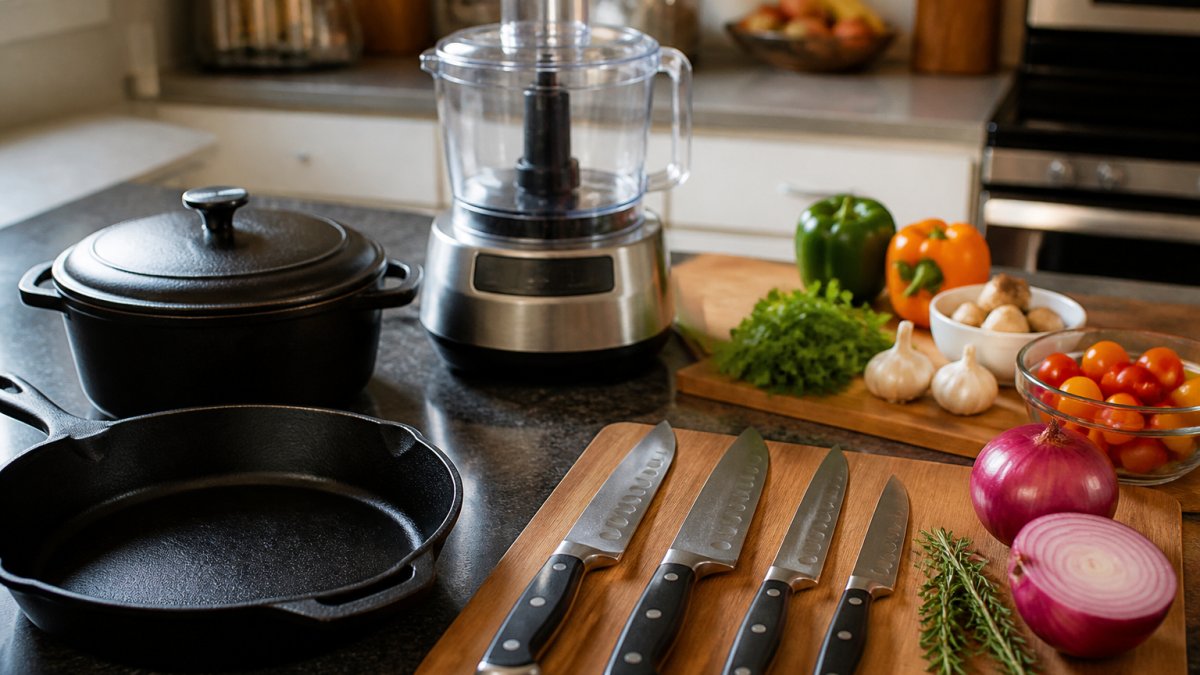
Cast-Iron Cookware: A Lifetime Investment
Cast-iron skillets and Dutch ovens are the gold standard for durability. A quality cast-iron piece costs between $50 and $150 new.

Cast iron distributes heat evenly, retains temperature longer than other materials, and actually improves with age.
The Lagostina 6-quart cast-iron casserole at Home Essentials Outlet costs $69.99 and handles everything from braising to roasting. It's the kind of piece that gets passed down.
Quality Chef's Knives and Food Prep Tools
A good chef's knife costs $30 to $100. A mediocre one costs $15 and dulls after three months of use. Over five years, you'll replace the cheap knife three times. You'll sharpen the quality knife once.
Food processors and immersion blenders fall into the same category. A $150 food processor lasts 10 years. A $40 one lasts 18 months. The math favors quality.
Multi-Function Appliances That Replace Multiple Gadgets
One appliance that does three jobs costs less than buying three single-purpose tools.
Similarly, the De'Longhi La Specialista espresso machine includes a built-in grinder, steam wand, and multiple brewing presets. It replaces separate purchases of a grinder, espresso maker, and milk frother.
Multi-function tools reduce clutter, lower total cost of ownership, and give you backup capabilities when one feature breaks.
Best Time to Buy Kitchen Appliances for Maximum Savings
Timing matters. Kitchen appliance prices fluctuate throughout the year based on retail cycles and seasonal demand.
Peak sales periods:
- January through March (post-holiday clearance, New Year resolution spending)
- May through June (summer entertaining season begins)
- September through October (back-to-school and fall entertaining)
Worst times to buy:
- April and August (slow retail periods with minimal discounts)
- Right after product launches (prices drop 20-30% within 6 months)
The best time to buy is when retailers need to clear inventory. That's when refurbished and factory-serviced items hit shelves at Home Essentials Outlet. These products have been inspected, tested, and certified to meet manufacturer standards. They come with our warranty but cost 30-50% less than new.
Walmart vs. Amazon for Home Appliances: Where to Find Better Deals
Both retailers offer competitive pricing, but they serve different shopping styles.
Walmart.ca excels at in-store pickup and local availability. You see the item, inspect it, and leave with it the same day.
Amazon.ca offers broader selection and fast delivery. Prime members get two-day shipping. Prices fluctuate based on seller inventory.
Neither offers the same value as Home Essentials Outlet for premium brands at outlet pricing.
How to Compare Kitchen Appliance Prices Across Retailers
Smart shopping requires comparing more than just sticker price. The strongest competitors focus on total cost of ownership, but equally important is understanding what makes a premium tool actually durable so your investment pays off.
Check Total Cost of Ownership, Not Just Sticker Price
The cheapest item isn't always the best deal. Calculate total cost over the expected lifespan by factoring in purchase price, expected years of use, warranty coverage, repair costs, and replacement parts.
Example: Food Processor
- Budget model: $60, typical lifespan 3 years, no parts available after 2 years, total cost = $20/year
- Premium model: $180, typical lifespan 10+ years, replacement motor $40, blade assembly $25, total cost = $18-22/year
The premium option costs similar or less per year despite higher upfront expense. The real advantage emerges when you account for the time and frustration of replacing a broken appliance mid-meal prep.
Factor in warranty coverage, repair costs, and replacement parts availability.
Identify Genuinely Durable Premium Gear Before You Buy
Not all premium-priced items are actually durable. Use these criteria to separate marketing from real quality:
DELONGHI EC9155MB La Specialista Arte Espresso Machine - Factory serviced →
Materials and construction:
- Cookware: Look for tri-ply or multi-ply bottoms (copper or aluminum core sandwiched between stainless steel). Single-ply heats unevenly and warps. Cast iron should be solid, not hollow.
- Knives: High-carbon stainless steel (such as German or Japanese grades) holds an edge longer than low-carbon or stamped blades. Full-tang construction (blade extends through the handle) is more durable than partial-tang.
- Appliances: Check if the motor is sealed or exposed. Sealed motors resist moisture and last longer. Look for metal gears rather than plastic in food processors and stand mixers.
Warranty and repairability:
- Does the manufacturer offer a warranty of at least 3 years for small appliances, 5+ years for cookware?
- Are replacement parts (blades, motors, seals, heating elements) available for purchase separately, or is the whole unit disposable?
- Can you access the interior for cleaning and maintenance, or is it permanently sealed?
Brand track record:
- Established brands with decades of history (such as Le Creuset for cookware, Wüsthof for knives, KitchenAid for stand mixers) have proven durability records and parts availability.
- Newer or trend-driven brands may offer lower prices but often disappear within 5-10 years, leaving you without warranty support or parts.
- Check online reviews specifically for long-term durability ("I've owned this for 5 years") rather than first-impression reviews.
Maintenance requirements:
- Items requiring minimal maintenance (stainless steel, sealed motors) cost less to own long-term than those needing regular seasoning, sharpening, or descaling.
- However, some maintenance (such as knife sharpening or cast-iron seasoning) is inexpensive and extends life dramatically. Factor this into your decision.
Evaluate Warranty Coverage and Repair Costs
Check what each warranty actually covers:
- Manufacturing defects only, or accidental damage and wear?
- How long is the coverage period, and does it transfer if you sell the item?
- Can you repair locally, or must items ship back to the manufacturer (adding 2-4 weeks downtime)?
Factory-serviced and refurbished items from reputable sellers often come with the manufacturer's original warranty or a seller warranty that covers the same terms as new. This removes the risk of buying secondhand.
Factory-Serviced and Refurbished Options: Real Quality at Real Discounts
Factory-serviced items are returns or overstock that have been inspected and certified by the manufacturer. They're not damaged goods.
These products pass the same rigorous testing as new items. They come with the same functionality and performance. The only difference is the price, which runs 30-50% below retail.
Home Essentials Outlet specializes in this inventory. Our team inspects every unit. We back everything with our own warranty.
When Not to Upgrade: Knowing What to Keep
Not every kitchen tool needs replacing. The most expensive purchase is one you don't use or one you buy before you're ready. Before upgrading, match the tool to your actual cooking habits and household needs.
Assess Your Cooking Frequency and Household Size
The value of premium gear depends entirely on how much you use it. A $300 stand mixer is a bargain for someone who bakes weekly; it's wasteful for someone who bakes twice a year.
Occasional cooks (1-2 times per week):
- Skip: High-end food processors, espresso machines, specialty appliances
- Keep: One good chef's knife, basic cookware, a reliable blender
- Rationale: You won't use the tool enough to justify the premium price. A mid-range option will outlast your actual need.
Regular cooks (4-6 times per week):
- Invest in: Quality cookware (cast iron, stainless steel), a sharp chef's knife, a food processor
- Skip: Single-purpose gadgets (spiralizers, egg cookers, waffle makers) unless you specifically crave that food
- Rationale: You'll use these tools enough that durability and performance directly reduce frustration and time spent cooking.
Meal preppers and large households (daily cooking, 4+ people):
- Invest in: Heavy-duty cookware, multiple quality knives, a food processor, a stand mixer if you bake
- Consider: Larger appliances (bigger blender, commercial-grade food processor) because they handle volume better
- Rationale: High-frequency use means premium gear pays for itself quickly. Durability matters more than cost.
Match Tools to Your Kitchen Space and Existing Equipment
Upgrading makes sense only if you have room and if the new tool doesn't duplicate what you already own.
Before buying, ask:
- Do I have counter or storage space for this item, or will it sit in a cupboard unused?
- Does this tool replace something I already own, or does it add new capability?
- If it replaces something, is my current tool actually broken, or am I just tempted by a newer model?
A $200 immersion blender is pointless if you already own a full-size blender and a food processor. A $400 espresso machine is wasteful if you're happy with a $15 pour-over and instant coffee.

Know When to Repair vs. Replace
Keep what you have if:
- It still performs its intended function reliably (even if slowly or with minor quirks)
- Repair costs are less than 40-50% of replacement cost
- You use it regularly enough to justify keeping it
Replace when:
- Repair costs exceed 50% of replacement cost
- The item breaks frequently or unpredictably (more than once per year)
- A newer version offers significant functionality gains that match your actual cooking needs
- You've outgrown its capacity (cooking for more people, different dietary needs, or a change in cooking style)
Common repair-vs.-replace scenarios:
- Dull knife: Sharpen it ($10-20). Replacement is unnecessary unless the blade is damaged.
- Sticky stand mixer: Clean the motor housing and replace the grease ($5-15). Replacement is overkill.
- Chipped cookware: If non-stick, replace it (coating is compromised). If stainless steel or cast iron, keep using it.
- Slow food processor: Clean the motor and blade ($0). If still slow, the motor is failing; replacement is justified.
The key is distinguishing between normal wear (which maintenance fixes) and actual failure (which replacement addresses). Premium gear is worth keeping because it can be repaired affordably. Cheap gear often can't be repaired at all, forcing replacement.
Frequently Asked Questions
When is the best time to buy kitchen appliances to get the lowest prices?
Kitchen appliances typically go on sale during major shopping events like Boxing Day, Black Friday, and end-of-season clearances (late August and January). Appliance manufacturers also release new models in spring and fall, which means older stock gets discounted. Buying factory-serviced models from outlets like Home Essentials Outlet offers year-round savings without waiting for seasonal sales, often providing 30-50% discounts on premium brands.
Are factory-serviced kitchen appliances actually reliable, or should I buy new?
Factory-serviced appliances are rigorously tested to meet manufacturer specifications and come with warranties backing their quality. The De'Longhi La Specialista espresso machine and Omega batch juicer available at Home Essentials Outlet are factory-serviced examples that deliver the same performance as new units at significantly lower prices. They may have minor cosmetic marks but function identically, making them an excellent value for budget-conscious buyers who want premium brands.
How do I know if a premium kitchen tool is worth the higher price?
Calculate total cost of ownership by considering durability, warranty length, repair costs, and how long you'll use it. Cast-iron cookware like the Lagostina 6Qt casserole costs more upfront but lasts decades with minimal maintenance. Quality stainless steel cookware sets like T-fal's 11-piece collection distribute heat evenly, reducing cooking time and energy use. Compare warranty coverage across retailers, and choose brands backed by manufacturer guarantees, not just seller promises.
Should I buy kitchen appliances from Walmart, Amazon, or a specialty outlet?
Walmart and Amazon offer convenience and competitive pricing, but specialty outlets like Home Essentials Outlet focus exclusively on premium brands at guaranteed lowest prices with dedicated warranties on factory-serviced items. Outlets typically stock deeper inventory of top-tier brands like De'Longhi, Omega, and Lagostina, and their staff can advise on long-term value rather than just price. For significant savings on durable, brand-name kitchen gear, outlets often beat big-box retailers on both price and selection.
Saving money on premium kitchen gear comes down to timing, smart comparisons, and knowing where to shop. Home Essentials Outlet makes this easier by offering factory-serviced premium brands at guaranteed low prices. Our rotating inventory and Home Essentials Warranty mean you get quality without compromise. Shop Deals today and discover how much you can save on the kitchen tools that matter.


