

Quick Summary
Yes, an oscillating multi-tool is worth it for home repairs if you regularly tackle small, awkward jobs like flush cutting trim, grout removal, scraping and detail sanding. Its strength is precision in tight spaces rather than raw power. It does not replace a circular saw, jigsaw or sander for long cuts or heavy material removal.
- Its best uses are flush cutting trim and door jambs, grout removal, and scraping adhesive or caulk.
- It is less useful for long straight cuts or heavy material removal, which still belong to a circular saw or jigsaw.
- Match the blade to the material, since using the wrong blade is the most common reason homeowners give up on it.
- Compare first-year total cost, including replacement blades, sandpaper and any battery you still need to buy.
- Buy one if you do these small jobs regularly; borrow one if your repairs are rare.
Table of Contents
- What a Multi-Tool Does Well in Home Repairs
- Oscillating Multi-Tool vs Individual Tools
- Cordless, Battery Compatibility and Corded Options
- Total Cost of Ownership, Including Accessories
- Best Oscillating Multi-Tool for Home Repairs: Our Picks from the Outlet
- Safety, Dust and Noise for Indoor Repair Work
- Buy, Borrow or Skip: Deciding on Your Next Repair Tool
- Frequently Asked Questions
What a Multi-Tool Does Well in Home Repairs
Last Updated: November 2, 2026
Yes, an oscillating multi-tool is worth it for home repairs if you tackle the small, awkward jobs that full-size tools handle poorly. Its strength is precision in tight spaces, not raw power. Homeowners often ask whether one tool really replaces several. The honest answer depends on which repairs you actually do.
The multi-tool earns its place on jobs that involve cutting, scraping, or sanding in places a saw or grinder cannot reach. Think trim behind a baseboard, grout between tiles, or a nail head in a tight corner.
Its best home-repair uses include:
- Flush cutting trim and door jambs
- Grout removal between tiles before regrouting
- Scraping old adhesive, paint, or caulk from corners
- Sanding detail areas that a random orbit sander cannot reach
- Cutting nails, screws, and small plastic or drywall sections
The tool is less useful for long, straight cuts or heavy material removal. Those jobs still belong to a circular saw or a jigsaw.
Oscillating Multi-Tool vs Individual Tools
A multi-tool does not replace a dedicated tool so much as cover the gaps between them. Its advantage is versatility: one body, many accessories. A dedicated tool generally wins on speed and power for its specific job. The useful question is not "which is better" but "which jobs does each one actually finish well."
Homeowners doing occasional repairs often find that a multi-tool handles the small, awkward jobs, while a jigsaw, circular saw, or random orbit sander handles the rest. If you already own a jigsaw and a sander, a multi-tool adds less than it would for someone starting from scratch. If you own neither, the multi-tool is often the cheaper way to cover several small tasks at once.
Task-by-Task: Where It Beats a Dedicated Tool and Where It Doesn't
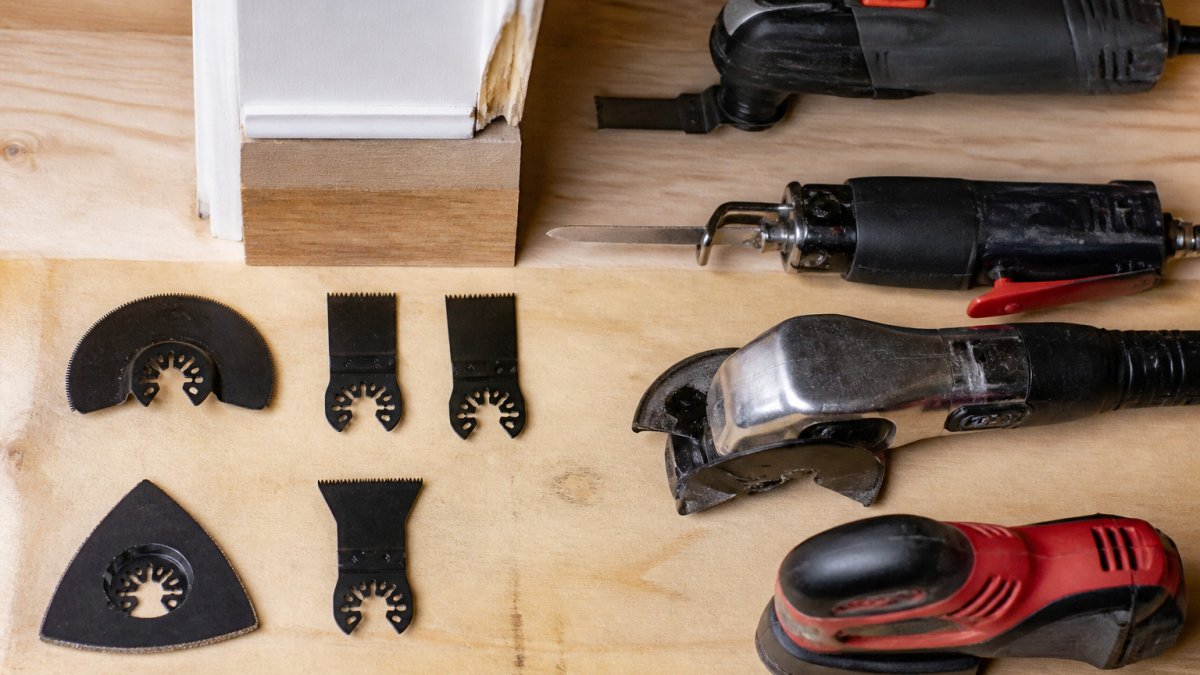
The multi-tool wins when precision and access matter more than speed. It loses when the job demands sustained power, long straight cuts, or heavy material removal. The oscillating head moves the blade side to side, which suits corners and detail work more than long cuts through thick stock. Just as the oscillating head excels in tight spaces, the versatility of multi-functional ladders provides similar adaptability when navigating the vertical constraints of a home renovation project.
-
Flush-cutting a door jamb: The multi-tool wins. A flush-cut blade sits against the floor or wall and trims the jamb without marring adjacent surfaces. A jigsaw risks marking the wall and cannot start a cut flush against a surface.
-
Removing grout between tiles: The multi-tool suits small grout lines, though it is slow over large areas.
-
Sanding a window sill or inside a cabinet: The multi-tool wins on corners and profiles. A random orbit sander leaves swirl marks and cannot reach into tight inside corners. Use a detail sanding pad and let the tool do the work rather than pressing hard.
-
Scraping adhesive or caulk from a corner: The multi-tool wins with a rigid scraper blade. A putty knife is cheaper but slower and harder on the wrist in tight spots.
-
Cutting a 2x4 to length: The circular saw wins. The multi-tool is slow and inaccurate over long straight cuts.
-
Ripping plywood or making long straight cuts: A dedicated saw wins outright. The multi-tool is not a substitute for a circular saw or jigsaw on sheet goods.
-
Cutting metal pipe or bolts: The multi-tool can do it with a metal blade, but a reciprocating saw or angle grinder is faster on thicker metal. The multi-tool wins only when access is tight.
Watch out: Use the correct blade type for each material, or you will spend more time replacing blades than cutting.
Cordless, Battery Compatibility and Corded Options
Cordless models give freedom of movement for many home repairs. The DEWALT DCS356D1 20V MAX XR kit runs on a 20V MAX lithium-ion battery, and that battery works with other DEWALT 20V MAX tools. The battery works with other DEWALT 20V MAX tools.
The DEWALT DCS353G1 uses a 12V MAX system with a 3.0Ah battery. Choose it when portability matters more than runtime and when you don't already own 20V batteries.
Corded models suit long sessions at a workbench, since you never worry about a flat battery. The trade-off is reach. Cordless wins for most homeowners because repairs rarely happen near an outlet.
Check battery compatibility before you buy. A 12V and a 20V system do not share batteries.
DEWALT DCS356D1 20V MAX* XR® Brushless Cordless 3-Speed Oscillating Multi-Tool →
Total Cost of Ownership, Including Accessories
Our refurbished DEWALT DCS356D1 kit is listed at $199.99 CAD and includes a 20V MAX 2.0Ah lithium-ion battery, charger, oscillating blade, sanding pad, sandpaper, accessory adapter, and kit bag.
The DEWALT DCS353G1 kit is listed at $169.99 CAD and includes two blades, a 12V MAX 3.0Ah battery, charger, and kit bag.
Accessories add cost over time. Blades wear out, especially on grout and metal, and specialty blades for flush cutting or plunge cutting usually cost extra. A realistic first-year calculation looks like this:
- Tool kit: the listed kit price, which includes the first blade or two and a sanding pad.
- Replacement blades: budget for several blades in the first year if you cut grout, metal, or hardwood. Carbide and bi-metal blades cost more than standard wood blades but last longer on tough materials.
- Sanding sheets and pads: a consumable if you sand trim, sills, or drywall patches. Buy sheets in packs rather than singly.
- Battery platform: if you already own DEWALT 20V MAX tools, the DCS356D1 adds capability without a new battery. If you do not, the kit price includes one battery and charger, but future bare tools will need the same platform.
- Corded alternative: a corded multi-tool usually costs less than a cordless kit and has no battery to replace, but you lose reach and need an outlet or extension cord.
For context, a dedicated jigsaw or sander might cost a similar amount, but you would need several of them to match a multi-tool's range. The multi-tool's value case is strongest when it replaces two or three small dedicated tools you would otherwise buy for occasional jobs, and weakest when you already own those tools and only need one new capability.
DEWALT 20V MAX battery platform compatibility
The first-year cost of a multi-tool goes well beyond the kit price, so it helps to add up the parts.
| Cost item | Value | Note |
|---|---|---|
| DEWALT DCS356D1 kit (refurbished) | $199.99 CAD | Includes 20V MAX 2.0Ah battery and charger |
| DEWALT DCS353G1 kit | $169.99 CAD | Includes two blades and 12V MAX 3.0Ah battery |
| Replacement blades | Several in year one | Budget more if cutting grout, metal or hardwood |
| Sanding sheets and pads | Buy in packs | Consumable for trim, sills and drywall patches |
| Corded alternative | Usually cheaper kit | No battery, but loses reach |
Best Oscillating Multi-Tool for Home Repairs: Our Picks from the Outlet
The DEWALT DCS356D1 offers a brushless motor, three speed settings, a Quick-Change accessory system, and an LED light, and it ships with several included accessories. To understand how discounted brand-name tools are sourced and sold, read our outlet guide.
Choose the DEWALT DCS353G1 if you need a lighter tool for tight overhead work and already have a plan for your batteries. It is a sensible option for light, occasional repairs.
If you do not need an oscillating tool at all, the Victorinox Camper ($29.99 CAD) and Huntsman ($39.99 CAD) Swiss Army knives cover small cutting and repair tasks in a pocket-sized package. They won't replace a multi-tool, but they handle quick jobs like trimming tape or opening packaging.
For a cordless drill and driver rather than an oscillating tool, the DEWALT DCK277C2 combo kit is listed at $189.99 CAD and suits most drilling and fastening work around the house.
Safety, Dust and Noise for Indoor Repair Work
Oscillating tools are quieter than many power tools, but they still produce fine dust when grinding grout, sanding, or cutting drywall. Wear a dust mask rated for fine particles, and use eye protection, since blades can throw debris.
Indoors, ventilate the room and cover nearby surfaces. A small shop vacuum attached near the cut reduces dust considerably.
Keep fingers clear of the blade, and unplug or remove the battery before changing accessories. Use the trigger lock on models that include one when you are not actively cutting.
Buy, Borrow or Skip: Deciding on Your Next Repair Tool
Buy a multi-tool if you regularly do flush cuts, grout removal, scraping, or detail sanding, and you don't already own a tool that handles these jobs well. The DEWALT DCS356D1 is our recommendation for most buyers.
Borrow one if your repairs are rare. A single weekend project rarely justifies the cost.
Skip it if your work is mainly long cuts, heavy demolition, or large-area sanding. A circular saw, jigsaw, or random orbit sander will serve you better.
Shop Deals at Home Essentials Outlet.
Frequently Asked Questions
What all does a multi-tool do?
An oscillating multi-tool does far more than one job. With the right blade or pad, it cuts flush against walls and trim, plunge-cuts into drywall and wood, sands tight corners, scrapes old adhesive and paint, removes grout and cuts through nails and screws. The DEWALT DCS356D1 kit, for example, lists cutting wood, plastic and drywall, removing grout, sanding detailed surfaces, scraping adhesives and paint, and flush cutting among its applications. Its usefulness depends on the accessories you own, which is why blade choice matters as much as the tool itself.
Is an oscillating multi-tool worth buying if you already own other tools?
It depends on what you already have. If you own a jigsaw, sander and scraper, a multi-tool adds less value because it duplicates them. Its advantage is reaching tight spots, working flush against surfaces and handling small detail jobs that the larger tools cannot reach. Homeowners who mostly do light repairs, trim work or grout removal often find it earns its place. Those who rarely do these jobs may not need one yet.
Can a multi-tool replace a jigsaw or a sander?
Not fully. A multi-tool can handle short cuts and detail sanding, but it is slower than a jigsaw on long or curved cuts and less efficient than a random orbit sander on large flat surfaces. Use it to replace these tools only when your projects involve small areas, tight corners or flush cuts. For bigger jobs, a dedicated tool still saves time and produces cleaner results.
Are cheap oscillating multi-tools worth buying?
Lower-priced models can work well for occasional home repairs, but durability, motor quality and accessory compatibility vary. Consider the total cost of ownership: a low purchase price means little if the tool lacks a quick-change system or the blades you need. Refurbished units backed by a manufacturer warranty, such as the DEWALT DCS353G1 at $169.99 or the DCS356D1 at $199.99, offer a middle ground for buyers who want brand performance without paying new-tool prices.


