

Quick Summary
Induction cooktops do not work with all cookware. Only pans with a magnetic base heat on an induction cooktop, usually magnetic stainless steel, cast iron or carbon steel, so check your pans for induction cookware compatibility before you buy.
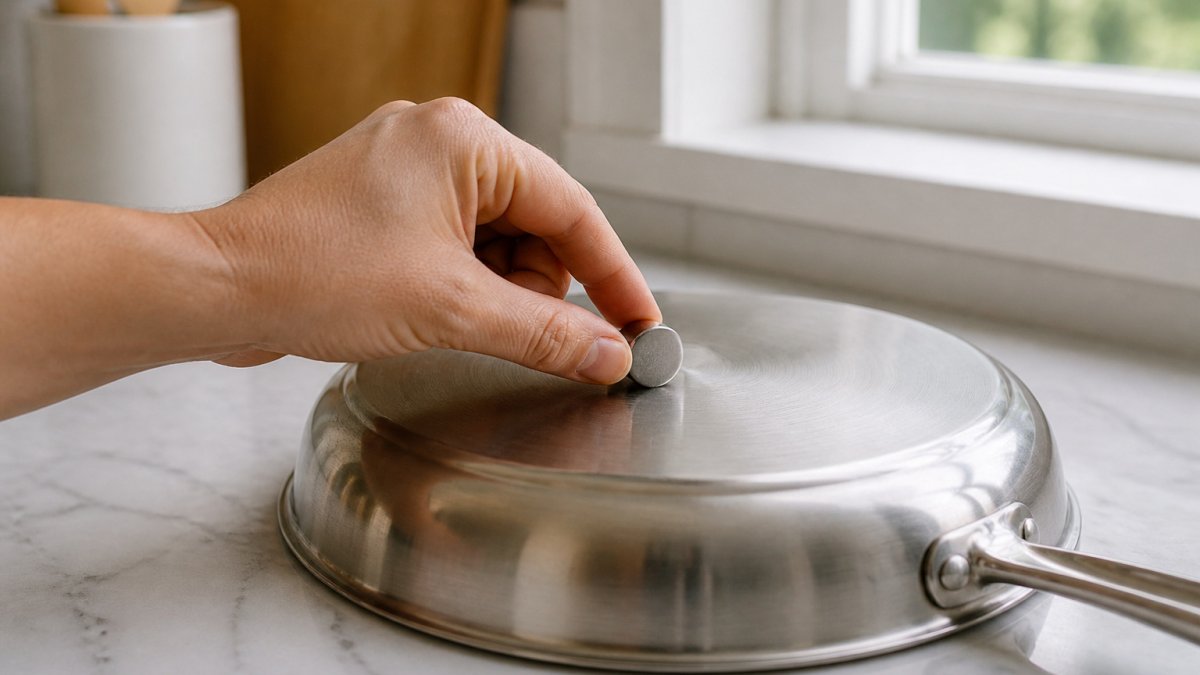
- Hold a refrigerator magnet against the flat base; a strong pull usually means the pan will work.
- Test the center and edges of the base, since a non-magnetic rim can cause uneven heating.
- Aluminum, copper and most glass cookware will not heat on induction unless they have a magnetic layer.
- Choose a pan size that matches your cooktop's cooking zone, as undersized pans may not be detected.
- Interface disks let non-magnetic pans heat but slow heating and make low-heat control harder.
Table of Contents
- Last Updated: November 4, 2026
- Do Induction Cooktops Work With All Cookware?
- How Induction Cooking Works and Why It Needs Magnetic Pans
- How to Test Pans for Induction With a Simple Magnet Test
- Cookware Materials That Work and Materials That Do Not
- Induction Compatible Cookware Symbols and Product Claims to Check
- Pan Size, Flat Bases and Using Induction Interface Disks
- Choosing Induction-Ready Pans for Your Kitchen Next
- Frequently Asked Questions
Last Updated: November 4, 2026
Last Updated: November 4, 2026
Do Induction Cooktops Work With All Cookware?
Induction cooktops do not work with all cookware. Only pans with a magnetic base heat on an induction cooktop, usually made from magnetic stainless steel, cast iron or carbon steel, so check your pans for induction cookware compatibility before you buy. This guide will help you check your pans before you buy a cooktop.
The good news is that you can usually find out in under a minute. A simple magnet test tells you most of what you need to know. Below, we walk through seven checks, from how induction works to picking new pans that match your cooktop.
Natural Resources Canada guidance on energy-efficient cooking appliances
How Induction Cooking Works and Why It Needs Magnetic Pans
Induction cooking uses an electromagnetic field to heat the pan itself. Coils under the glass surface create a magnetic field. When a magnetic pan sits on the cooktop, that field makes the base heat up quickly.
The cooktop surface stays cooler than the pan. Remove the pan, and the heating stops almost right away.
Because the pan does the heating, the pan must respond to a magnet. Aluminum, copper and most glass cookware do not do this on their own, so they will not heat on an induction cooktop unless they have a magnetic layer.
How to Test Pans for Induction With a Simple Magnet Test
The magnet test is the quickest way to check your cookware. Grab a refrigerator magnet and hold it against the bottom of the pan.
- Strong pull: The pan will likely work on induction.
- Weak pull or no pull: The pan probably will not work.
- Pull only in spots: The base may have a thin or uneven magnetic layer, so the heating may be uneven.
Test the center and the edges of the base. A pan with a magnetic center but a non-magnetic rim may heat unevenly. Look for a pan that pulls strongly across the whole bottom.
Watch out: a magnet that sticks to the handle or the outside wall tells you nothing about the base. Always test the flat bottom.
Cookware Materials That Work and Materials That Do Not
Material labels alone can mislead you. Two pans that both say "stainless steel" can behave differently on induction depending on how the base is built. The table below gives the quick answer, and the notes underneath explain the exceptions that matter.
| Pan material or construction | Likely induction-compatible? | Key exception to check | Simple verification |
|---|---|---|---|
| Cast iron (bare or enameled) | Yes | Enamel coating must be intact; very rough bases can scratch glass | Magnet test on the bare base |
| Carbon steel | Yes | Thin bases can warp over high heat | Magnet test plus a straight-edge check |
| Magnetic stainless steel (e.g., 18/0 or ferritic grades) | Usually yes | Some stainless grades are non-magnetic | Magnet test across the whole base |
| Multi-layer clad stainless steel | Usually yes | The magnetic layer must reach the bottom surface, not just an inner layer | Magnet test on the cooking surface side of the base |
| Encapsulated-base aluminum or copper | Sometimes | A magnetic disk is sealed inside; if it does not contact the cooktop, the pan may not register | Magnet test on the very bottom |
| Pure aluminum | No | Anodized aluminum is still non-magnetic | Magnet test |
| Pure copper | No | Lined copper pans are still non-magnetic unless they have a magnetic base | Magnet test |
| Glass and most ceramic | No | Some ceramic-coated pans have a magnetic metal core | Magnet test on the base |
| Nonstick-coated pans | Depends on the core | The coating is irrelevant; the base metal decides | Magnet test on the base |
Materials that usually work:
- Cast iron, including enameled cast iron
- Carbon steel
- Magnetic stainless steel (check with the magnet test)
- Some multi-layer clad cookware with a magnetic base
Materials that usually do not work:
- Pure aluminum
- Pure copper
- Glass and most ceramic cookware
- Some stainless steel, especially non-magnetic grades
Why construction matters more than the label:
- Clad pans bond layers of stainless steel and a magnetic metal (often a ferritic stainless) together. The pan works only if the magnetic layer is part of the exterior base that touches the cooktop.
- Encapsulated-base pans hide a magnetic disk inside an aluminum or copper body. If the disk sits above the bottom surface or is too small, the cooktop may not detect the pan even though a magnet sticks.
- Coated pans (nonstick, ceramic) rely entirely on the core metal underneath. A nonstick aluminum pan will not work; a nonstick pan over a magnetic stainless core usually will.
- Bonded-base pans with a stamped disk can develop a gap between the disk and the body over time, which weakens the magnetic response.
Health Canada guidance on nonstick and cookware safety
Induction Compatible Cookware Symbols and Product Claims to Check
Many pans carry an induction symbol, which looks like a coil or a series of wavy lines. This symbol is a helpful sign, but it is not a guarantee. Some manufacturers print it on packaging. Others stamp it on the base.
T-FAL G758S274 Essentials 2PC Fry Pan Stainless Steel →
Read the product claims carefully and confirm them with the magnet test. Packaging can also list induction-ready features, such as a magnetic base or a multi-layer design.
When a symbol is missing, do not assume the pan will fail. Check the base with a magnet. A clear pull tells you that the pan will likely work.
Pan Size, Flat Bases and Using Induction Interface Disks
A pan can pass the magnet test and still fail on the cooktop. Compatibility is not only about magnetism; the pan also has to be the right size, sit flat, and land on a cooking zone that can detect it. This section covers the checks that solve most "my pan won't work" problems, plus what an interface disk can and cannot do.
Minimum pan diameter and zone matching
- Most induction cooktops have a minimum pan diameter for each cooking zone, often around 4 to 5 inches (roughly 10 to 12 cm) for small zones, though the exact figure is in your appliance manual. A pan smaller than the minimum may not be detected at all.
- Match the pan base to the zone size printed around the ring. A base much smaller than the zone wastes energy and may not register; a base much larger than the zone can heat unevenly and may overhang the edge.
- On a multi-zone or flex-zone cooktop, the pan must cover enough of the zone for the sensors to recognize it. Off-center placement is a common cause of detection failure.
Flat-base checks
- Induction works best with a flat base that sits fully on the glass. A warped or curved bottom makes poor contact and heats slowly or unevenly.
- Check flatness with a straight edge or by spinning the pan on a flat counter; a pan that wobbles has a warped base.
- Heavy cast iron can warp over time, especially if heated empty or cooled quickly. A warped cast-iron pan may still pass the magnet test but heat poorly.
When the pan passes the magnet test but the cooktop does not recognize it
- Confirm the pan is centered on the zone and within the minimum diameter.
- Lift and reset the pan; some cooktops need a brief pause to re-detect.
- Check the base for warp, burrs, or a recessed center that keeps the magnetic layer off the glass.
- Try the pan on a different zone to rule out a zone-specific issue.
- Consult the appliance manual for minimum pan size and any zone-specific limits.
- If the pan is a clad or encapsulated design, confirm the magnetic layer is on the exterior bottom, not buried inside.
Watch out: a pan that is magnetic but too small for the zone can trigger a detection error that looks like a cookware problem when it is really a sizing problem.
Induction interface disks and their trade-offs
- An interface disk is a thin metal plate placed between the cooktop and a non-magnetic pan. It gives the cooktop something magnetic to detect so the pan can heat.
- The disk adds a layer between the coil and the pan, which slows heating and reduces efficiency. Expect longer preheat times and less precise low-heat control.
- Temperature response is less immediate, so simmering and delicate sauces are harder to manage.
- A disk that is too small for the pan can create hot spots; choose a disk that matches or slightly exceeds the pan's base.
- Disks can scratch glass cooktops if grit gets trapped underneath, so keep both surfaces clean.
- Think of a disk as a short-term fix for an existing pan, not a long-term plan. If you cook on induction regularly, buying induction-ready pans is the better investment.
Safe use and care on induction
- Lift heavy pans rather than sliding them to avoid scratching the glass.
- Check both the cookware and cooktop instructions, especially for heavy cast iron, which can stress the surface if dropped.
- Keep bases clean; debris between the pan and the glass can cause hot spots and detection problems.
Choosing Induction-Ready Pans for Your Kitchen Next
If you are shopping for new pans, look for magnetic stainless steel or cast iron. Choose induction cookware with a flat base and a size that fits your cooking zone. Test each pan with a magnet before you check out.
Our T-FAL G758S274 Essentials 2PC Fry Pan Stainless Steel set, priced at $24.99 CAD, is a simple way to start with two common sizes. For a bigger upgrade, the LAGOSTINA L996612612 Artigiano 12 PC 3 Ply Clad Hammered Stainless Steel Cookware Set is priced at $279.99 CAD and includes a full range of pot and pan sizes.

Pair your pans with a cooktop that suits your kitchen. The BYORIENT IX3050 1500W Induction Cooker is a compact countertop option, priced at $59.99 CAD, and is factory serviced with the Home Essentials warranty. For budget-friendly cookware sets, the T-FAL 2100140681 Gourmet Stainless Steel 11 PC Pots and Pans Cookware Set is priced at $159.99 CAD.


Before you buy, check the warranty and return details on each item. Review the warranty terms on each product page.
Frequently Asked Questions
How do I know if my cookware is induction compatible?
Hold a fridge magnet to the bottom of the pan. If it sticks firmly across the base, the pan has a magnetic layer and will work on an induction cooktop. Check the base for an induction symbol, which is a coil icon, and confirm the flat base is wide enough for the cooking zone. A weak or patchy pull means the pan may heat poorly or not at all, so test before you buy any new set.
Do cast iron pans work on induction cooktops?
Yes. Cast iron is ferromagnetic, so it works well on induction, including enameled cast iron. Its weight and heat retention make it a strong choice, but the base must be flat to stay in full contact with the glass cooktop. Warped cast iron can heat unevenly or fail to register, so inspect the base before cooking.
What happens if you use non-induction cookware on an induction cooktop?
The cooktop will not heat the pan. Most induction cooktops detect that no magnetic base is present and show an error code or simply do not switch on the cooking zone. Aluminum and copper pans without a magnetic layer will not heat, and the cooktop will not be damaged by the attempt. Use a compatible pan or an interface disk instead.
Is there an adapter for non-induction cookware?
Yes, an induction interface disk is a flat metal plate you place on the cooktop under a non-magnetic pan. It heats up and passes that heat to the pan. Disks are slower and less efficient than true induction cookware, and they can hide overheating, so use them only for occasional cooking with pans you cannot replace.


