

Last Updated: October 25, 2026
Quick Summary
Factory serviced tools are reliable because each unit is a pre-owned return that a manufacturer's authorized service center has inspected, tested, and repaired to original specifications before resale. They arrive in like-new working condition with minor cosmetic blemishes possible, and typically carry a six-month warranty rather than the one-year-plus coverage on new tools.
- Factory serviced tools are returns checked and repaired by an authorized service center, not a back-room rebuild.
- Inspect chuck, battery contacts, trigger, motor sound, and casing in that order before buying.
- Serviced tools commonly carry a six-month warranty, while new tools often carry one year or longer.
- Battery condition decides whether a cordless kit is a bargain or a paperweight.
- Stay on one battery platform so packs and chargers swap between your tools.
Table of Contents
- What Factory Serviced Tools Actually Means
- How to Inspect Used Power Tools Before You Buy
- Reliability Evidence: What Factory Servicing Does and Does Not Guarantee
- Reconditioned Tools Warranty: Terms, Length, and Claims
- Battery and Charger Condition on Cordless Kits
- Matching the Tool to the Job: A Decision Framework
- Shop Factory Serviced Tools at Home Essentials Outlet
- Frequently Asked Questions
What Factory Serviced Tools Actually Means
Factory serviced tools are pre-owned power tools that a manufacturer's authorized service center has inspected, tested, and repaired to meet original specifications before resale. The term describes a process, not a grade of damage.
That distinction matters because "factory serviced" gets used loosely across the resale market. A tool rebuilt in a back room is not the same as one processed through a manufacturer's service channel.
Factory Serviced vs. Factory Reconditioned Tools
The two terms overlap, but they signal different things. Factory serviced usually means the tool was returned, checked, and brought back to working order by an authorized service center. Factory reconditioned tools typically go through a fuller rebuild: worn parts swapped, firmware reset, full function testing.
In practice, both arrive in like-new working condition. Both may carry minor cosmetic blemishes. Neither is a new tool, and neither should be priced like one.
What most guides miss is that the label matters less than who did the work. A manufacturer-backed program has documented test records. A third-party rebuild often does not.
Where Factory Seconds Tools Fit In
Factory seconds are a different category entirely. These are new tools with a cosmetic flaw, a packaging defect, or a discontinued finish.
So factory seconds sit closer to new than to serviced. If you want a tool that has never left a box, a factory second is the safer bet.
For a closer look at how to judge cosmetic flaws before you commit, see our guide on how to spot quality factory seconds.
How to Inspect Used Power Tools Before You Buy
Inspect the tool in person whenever you can, and check five things in this order: chuck, battery contacts, trigger, motor sound, and casing. Those five checks catch most problems a refurbished tool can hide. If you are buying online, apply the same list to the product photos and the return terms. The same close inspection matters when judging recycled chainsaw parts, since worn contact points, controls, or casing can reveal more than a listing description.
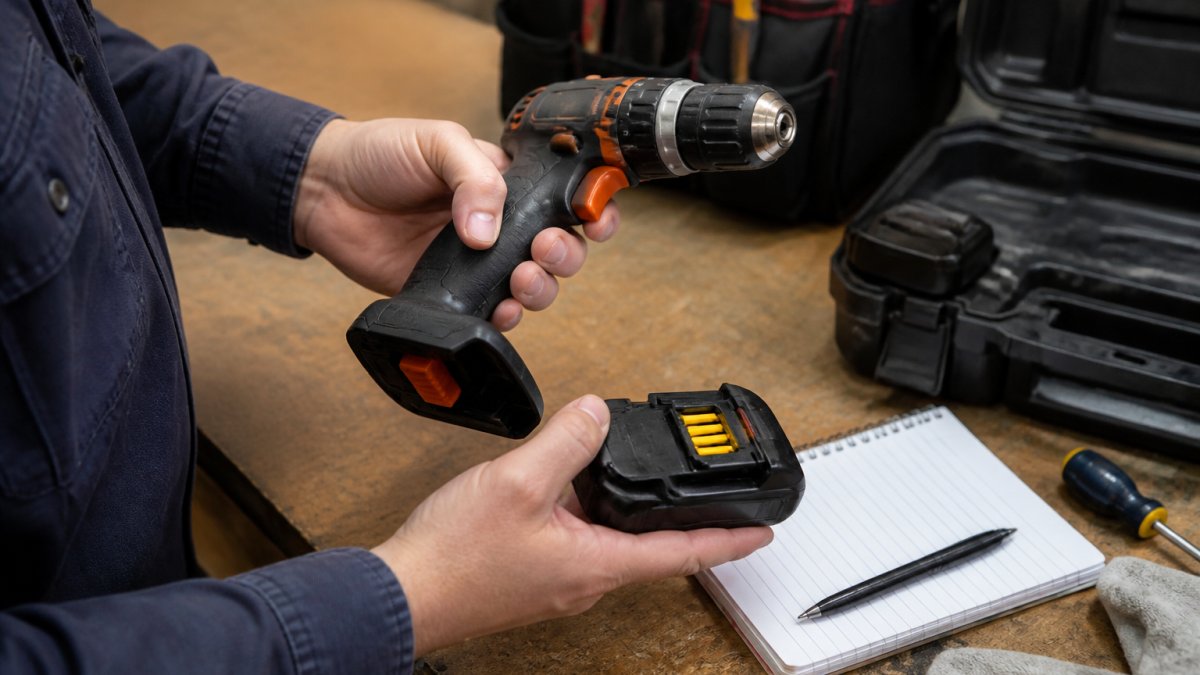
A Pre-Purchase Checklist for Reconditioned Tools
Run through this before you pay. The first four checks are about what is in the box; the rest are about the tool itself.
Packaging and contents
- Confirm the listing states whether original packaging, manuals, and accessories are included. Serviced tools often ship in plain packaging, and missing accessories are the most common surprise.
- Check that the charger, batteries, blades, bits, and case match what the kit is supposed to include. A bare-tool listing that looks like a kit is a common trap.
- Look for a serial number on the tool and confirm it matches the paperwork. A missing or scratched-off serial number makes warranty claims difficult.
Wear and condition
- Spin the chuck by hand. It should turn smooth, with no grinding or wobble.
- Look inside the battery slot. Clean contacts, no corrosion or bent pins.
- Check the casing for cracks near the vents and the battery foot, and look at the wear pattern on the grip and trigger. Heavy wear there suggests the tool saw more use than the listing implies.
Operation
- Squeeze the trigger slowly. Speed should ramp up, not jump or cut out.
- Listen to the motor at full speed. A steady whine is fine; rattles and clicks are not.
- Run the tool under a light load if you can, drill into a scrap of wood, drive a screw. A tool that spins freely but stalls under load has a weak motor or a failing switch.
Paperwork and recourse
- Confirm the warranty length and who honors it.
- Confirm the return window and who pays shipping.
- Ask whether the battery and charger are covered, and whether they are new or refurbished.
A common mistake is skipping the trigger test and the load test. Variable speed switches wear out quietly, and a tool that runs at full power can still be useless for delicate work. The load test is the one check that separates a tool that passed a bench test from one that will actually do the job.
For more buying tactics, our guide on tips for buying discounted power tools covers how to time a purchase and what to skip.
Reliability Evidence: What Factory Servicing Does and Does Not Guarantee
Factory servicing guarantees the tool passed a documented inspection and met the manufacturer's specs at the time of testing.
Here is the honest split:
What it does guarantee:
DEWALT 20V MAX* Cordless Drill and Impact Driver, Power Tool Combo Kit →
- The tool was tested against manufacturer specifications
- Defective parts were replaced or the unit was scrapped
- You get a written warranty with a claims process
What it does not guarantee:
- Zero cosmetic wear
- Original retail packaging or all accessories
- The same lifespan as a brand-new unit
Reliability over time comes down to how hard the tool was used before it was returned. Most returns are buyer's remorse, not breakdowns.
Many buyers find that a serviced tool from a known brand outperforms a cheap new one from an unknown brand.
Reconditioned Tools Warranty: Terms, Length, and Claims
Reconditioned tools warranty terms are shorter than new-tool coverage, and the length tells you how much confidence the seller has. A six-month manufacturer warranty is common on serviced power tools.
Check these six things, in this order:
- Who honors it. The manufacturer or the reseller? A manufacturer warranty is stronger because the service network already exists and the claim does not depend on one seller staying in business.
- When coverage starts. Most serviced-tool warranties start on the date of purchase, not the date the tool was originally made. Confirm the start date in writing, because a tool that sat in inventory can lose months of coverage before you open the box.
- What it covers. Motor and electronics usually; wear items like blades, bits, chucks, and batteries usually not. Ask specifically whether the battery and charger are covered, since those are the most expensive parts to replace on a cordless kit.
- What voids it. Common exclusions include opening the housing, using non-original batteries, and damage from overload or moisture. A warranty that is voided by normal jobsite dust is not much of a warranty.
- How you claim. In person at an authorized service center, by mail, or through the reseller. A service center you can drive to is faster than a mail-in process, especially for a heavy tool.
- Who pays shipping. This is the detail buyers forget. A warranty that requires you to ship a heavy tool at your own cost can erase the savings on a cheap unit.
A practical comparison: new tools typically carry one-year coverage or longer, while serviced tools commonly carry six months. That does not make serviced tools a bad buy, but it does mean you should price the shorter coverage into your decision. If the savings are small, the extra warranty on a new tool may be worth more than the discount.
The DeWalt kits we stock carry a six-month DeWalt warranty, which means claims go through the manufacturer, not through us. Before you file anything, our guide on how to verify appliance warranty coverage walks through the paperwork.
Battery and Charger Condition on Cordless Kits
Battery condition decides whether a cordless kit is a bargain or a paperweight. Lithium-ion packs lose capacity with every charge cycle, and a worn pack can cost more to replace than the tool saved you.
Check these before buying any cordless kit:
- Age of the pack. Ask for the manufacture date if it is printed on the label.
- Capacity rating. A 4.0Ah pack holds more runtime than a 1.3Ah pack.
- Charger included. Some bare-tool listings exclude it.
The DeWalt 20V MAX combo kit we carry includes two 1.3Ah battery packs and a charger, which suits light DIY work. For longer sessions, step up to a kit with a 4.0Ah or 5.0Ah pack.
Matching the Tool to the Job: A Decision Framework
Pick the tool by the job, not by the discount. A cheap tool you never use is worse value than a serviced tool you use weekly. Use this framework:
| Your situation | What to buy | Why |
|---|---|---|
| Light DIY, occasional repairs | Serviced drill/driver combo kit | Covers most drilling and fastening tasks |
| Deck building, fencing, framing | Serviced hammer drill or impact driver | More torque for long screws and masonry |
| Furniture assembly, cabinet work | Compact impact driver | Fits tight spaces, less wrist strain |
| Sanding, trimming, grout removal | Oscillating multi-tool kit | One tool, many blades |
| Lawn edging and overgrowth | Cordless string trimmer kit | Shares the same battery platform |
| Woodworking, routing, edging | Cordless router | Variable speed for control across materials |
Two rules make this simple. First, stay on one battery platform so packs and chargers swap between tools. Second, buy the smallest tool that does the job well; bigger tools cost more and tire you out faster.
For a deeper look at what a serviced unit really means, read are factory refurbished tools reliable.
Shop Factory Serviced Tools at Home Essentials Outlet
Home Essentials Outlet stocks factory serviced power tools from brands you know, priced well below new, and backed by our own warranty.
Our DeWalt lineup covers the jobs most homeowners actually face. The DEWALT 20V MAX drill and impact driver combo kit at $189.99 handles drilling and fastening in one box, with a brushless motor and a compact frame for tight spots.

Every kit carries a six-month DeWalt warranty. If something fails, the claim goes through DeWalt, and our team can walk you through the process. Shop Deals
Frequently Asked Questions
Are factory serviced tools reliable enough for regular DIY use?
Yes, for most homeowners and DIY projects. Factory serviced tools pass a rigorous inspection and dozens of tests to meet manufacturer specifications before resale, so the working parts perform like new. The trade-off is cosmetic: you may see minor blemishes on the housing. For tasks like drilling, driving, sanding, and trimming, a factory serviced DEWALT kit such as the DCK277C2 combo at $189.99 handles the same jobs as a new unit. Check the warranty length and return policy first, then match the tool to your project.
Do reconditioned tools warranty terms cover batteries and chargers?
It depends on the listing, so read it before you buy. At Home Essentials Outlet, factory serviced DEWALT kits are backed by a 6 month DEWALT warranty, and kits that include batteries and a charger list those items in the box contents. Confirm which components the warranty names and how a claim is handled: whether you ship the tool back or return it in person. Keep your receipt and the original packaging, since most warranty claims ask for proof of purchase and a description of the fault.
How do factory serviced tools differ from factory seconds tools?
Factory serviced tools are typically returns that have been inspected, tested, and repaired to meet manufacturer specifications, then resold with a warranty. Factory seconds tools are usually new units pulled from the line for a cosmetic flaw or a minor defect, with no repair history. The practical difference is what has been checked: a serviced tool has a documented inspection behind it, while a second may never have been tested beyond the factory's standard quality control. Ask which category a listing falls into before you compare prices.
What should I check before buying a reconditioned power tool?
Start with four things: the purchase source (an authorized seller with a stated warranty), the warranty length and what it covers, the return window and who pays shipping, and the box contents (battery, charger, case, blades). Then inspect the tool itself: spin the chuck, check the battery contacts for corrosion, test the trigger and speed settings, and look for cracks in the housing. A tool condition note mentioning minor wear is normal; missing accessories or a vague warranty are reasons to walk away.
Buying a serviced tool is a bet on the inspection behind it, so buy from a source that stands behind the warranty. Home Essentials Outlet stocks brand-name factory serviced tools at outlet prices, backs them with our own warranty, and adds a +1 Guarantee for purchase protection. Get started with Home Essentials Outlet and put a pro-grade tool in your kit for less.


